Opticourses VII: Kerry James Marshall

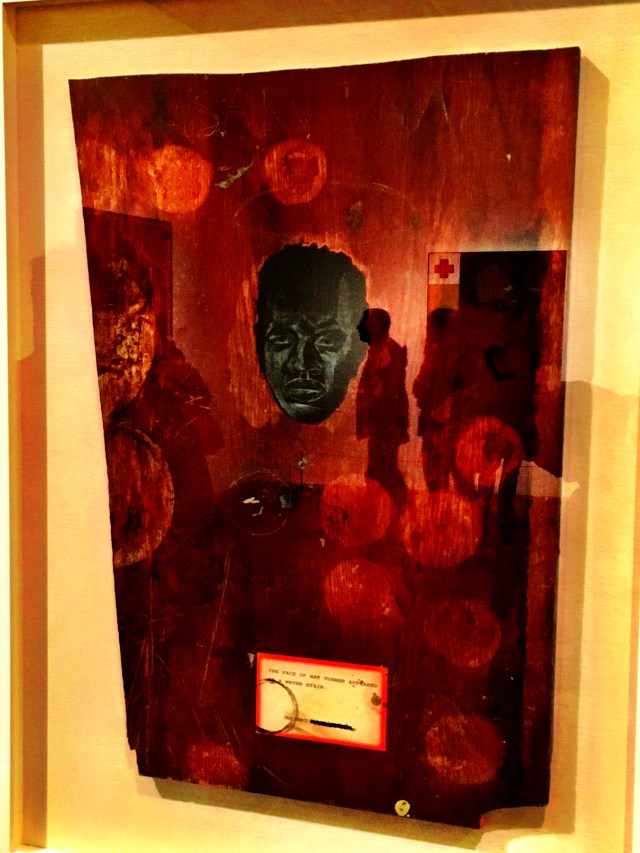
While in New York, my wonderful friends had planned a slew of great activities to attend during my stay. One of the most impressionable ones was at the The Metropolitan Museum of Art’s Breuer, a show on Kerry James Marshall’s retrospective titled “Mastry”; and mastery is exactly what he displays. I fell in love with art as a child growing up in Hollywood and having elementary school field trips which exposed us to LACMA and the La Brea Tar Pits Museum. There lies an inexplicable fascination with the ability of someone, whom I have not met in person, to evoke feelings through a “muted” object of their own creation. To speak in a silent language, one that may be devoid of sound but not of breath. Marshall’s retrospection took me through a spectrum of emotion. From his beautiful series on Black love and romance, to the social critiques on the history of lynchings and police brutality, to depicting cultural spaces significant within U.S. African-American communities, the show is advertised as Marshall’s “largest museum retrospective to date,” yet leaves one wanting more. I was especially taken aback by the very first piece I saw from his show “The Face of Nat Turner Appeared In A Water Stain” (1990).
Kerry James Marshall, Nat Turner, Black Art

While the image obviously references an important historical figure within U.S. history of resistance, what struck me was his use of medium: a found object, a stained wood board where he painted the Nat Turner’s face. A small inscription in the foreground states reiterates the art piece’s title: “The face of Nat Turner appeared in a water stain.” What struck me about this piece was the influence I believe Mexican culture has had on Marshall’s work. Having lived in Los Angeles most of his life, this piece echoes with Mexican Catholic iconography, specifically with los retablos also used to commemorate the many, many saints and regional Virgin Marys.

retablosWhile Marshall’s work is extremely minimal, incorporating his signature black tone paint, the reverence found in Mexican retablos is eloquently replicated in his piece. His work appears to also reference the constant appearance of Catholic figures such as Jesus and Virgin Mary, imprinting themselves on mundane items such as a tortilla, a tree stump, or even a grilled cheese sandwich. To have Nat Turner appear in a water stained piece of wood, would not be surprising provided the historical context Marshall gives his piece, a savior in human form, advocating for an oppressed group of people, choosing to clandestinely emerge not in a public forum like a church but instead on an intimate and disposable household item. The artist’s retrospective allows these and many other ideas to flow, Marshall’s 35-year career has documented an existence that continues to fight for their right to exist and persist. The show at the Met Breuer concludes at the end of this month and will make a quick transition to Los Angeles’ Museum of Contemporary Art in March. While it is not clear as to whether the curators will replicate the show with the same pieces I saw in New York, the exhibit without a doubt will resonate with Angelenos, sparking conversations on how Marshall’s career and his creations continue to speak in a language where words are simply not enough or even needed.
Opticourses VI: Subverting Semiotics

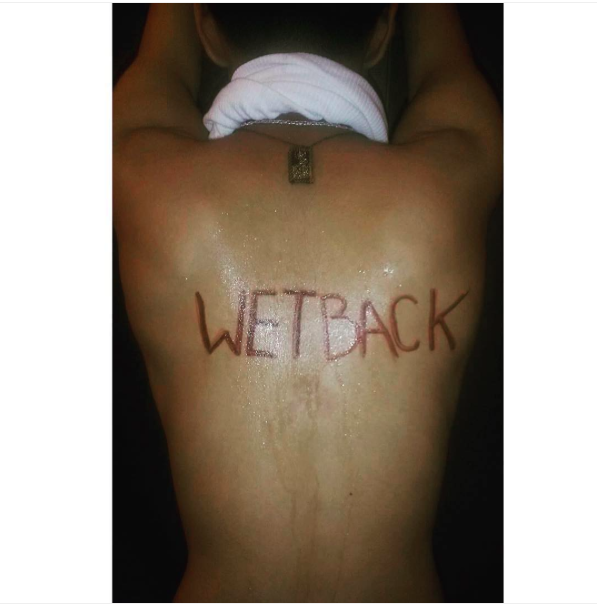
The last few weeks I have been reflecting on language, its power and its intent. I recently accepted a position as an Assistant Professor of Spanish at West Los Angeles College which has taken me back to one area of my educator roots: teaching Spanish to non-heritage language speakers. I immediately went from teaching my last summer course at UCLA in Chicana/o Studies to changing institutions and adapting my pedagogy to a new student population. My future projects and research ideas are now working towards focusing on how they will translate and work with my new campus, colleagues, and students. One of the last projects I had my UCLA students do was tied to the digital visual project I spoke about in my last post, which received a mostly positive response from my summer students. We discussed and dissected a variety of issues, including discourses (or lack thereof) by the current presidential candidates, which have mostly been exhausting, to say the least. One word that came up in the classroom was the use of the term “wetback” by Chican@s and non-Chican@s alike. I discussed its usage, linking it to the Mexican government sponsored film, Espaldas mojadas (1955), while also talking about its historical usage to categorize Mexican and Mexican-American populations as foreigners, disposable objects, and non-desirables. Our conversation was fruitful, so much so that one student spoke about subverting the term and how we can pull agency from it, even though historically and presently there have been and are multiple attempts to continue this practice. Below is my student’s submission for her visual project, and I hope that it helps us to further reflect upon the power of our language:

Wetback, Undocumented Immigration, LA Visual Representations
Photo Credit: Alondra Correa-Bautista @ohaiialondra69

“My father works two jobs, six out of seven days a week. His fingers and toes are calloused; his body is weak. He suffers from high blood pressure, but never complains about feeling sick, at least not until he’s hospitalized. My mother works just as hard, fulfilling a domestic role while juggling a full time job. Though she is petite, small and dainty, she carries boxes twice her weight – bruising her body and ignoring fatigue in order to keep food on our family’s plates. My parents are hard workers. They crossed the Sonoran Desert by foot, withstanding treacherous conditions and hiding from circling helicopters for two days and three nights just to build a life in a country where they’re not valued or measured by the content of their character, but rather criticized for having “WETBACKS”. Like other Latinx and Chicanx people, my parents overexert themselves physically, in hopes of making ends meet. They budget like crazy and put aside their wants, as well as their needs. Their health comes second and children come first; they don’t ever have time to worry about feeling tired because they only have time to provide for our family. Earlier today, my mother, older sister and I, were targeted by a black man for being “WETBACKS”. We were called “lazy”, “uneducated” and “broke”. The cherry on top was being accused of depending on the government for financial support – a government which we contribute to through our paying taxes, so even if we did, what does it matter? This image is dedicated to the black man who judged my family based on our complexion, on our exterior that reflects the Anti-Immigrant/Anti-Latino Sentiments Republican Party Nominee, Donald Trump, proudly promoted. This image is dedicated to those who make a living off of their sweat in order to survive, to my undocumented brothers and sisters who feel caught in the in-between, en la frontera que divide nuestras identidades. Let’s never dry our backs for there is no shame in having a wetback when the same sweat that drips from our bodies is the same sweat that nourishes us.”

Opticourses V: Chican@-Latin@ Visual Representations

Caution

This Spring Quarter I have begun a digital archival project with my students that I have titled @lavisualrepresentations via Instagram. Currently it is at the nascent stage, only having the one post I uploaded before the first day of class. I hope that by the end the quarter, I will have 40+ unique student posts describing in their own words how they understand, view and analyze the presence of Chican@s and Latin@s in Los Angeles. Here’s what I wrote for mine:

In recent decades, cities in South East Los Angeles have become majority Latina/o, and it is not a surprise that this area has a large immigrant population, mostly from Latin America. Due to the lack of immigration reform in the United States, those that live in this area as undocumented students, workers and/or families are in constant fear of forced deportation.  Recent California state legislator through Governor Jerry Brown has given undocumented immigrants access to state-issued driver’s licenses. The program has had some success, with the New York Times reporting that within the first six-months of the passing and implementation of Assembly Bill 60, more than 50% of the California Driver’s Licenses were issued to undocumented immigrants. While this proves to be an important milestone in recognizing undocumented immigrants as a vital component in California’s economy, there continues to be a disconnect between federal policy, (which has not approved California’s approach to the immigrant population), and continues to deport as well as break up mixed status families while employing ICE agents trained to search for undocumented immigrants. In the meantime, outreach to immigrants regarding new laws and policies has been limited, with most information being online and appointments normally available during work-week hours which is when the majority of people are working to support themselves and their families. With many undocumented immigrants continuing to drive without a state license, it is not uncommon for areas such as SELA to have make-shift warnings or caution signs informing folks about DUI checks down the street, which routinely ask for the driver to produce their license. While driving down Imperial Highway, I knew what the sign meant by “Check Point Ahead”; it also forced me to pause and think about how the sign has two potentially divergent meanings to its reader. In a city where more than 50% of its population speaks a second language outside of English, the most dominant being Spanish, “Check Point Ahead” may not need translation, but its words definitely placed the Latina/o immigrant experience at the forefront. #LAVisuals #CCS111

Opticourses IV: Prometo ser…

ElyGuerraAt the end of the Spring Quarter UCLA announced their UC Regents’ Lecturers for 2015-2016, to the excitement of many, Mexican feminist songstress Ely Guerra was one of those selected few. If you’ve never heard of her or come across her brilliance, I strongly suggest you check out her video for her song “Yo no,” an unnerving critique on Mexico’s femicide epidemic. Part of Guerra’s lectureship not only included a visit to converse with Professor Héctor Calderón in his class on Mexican Literature and Culture (he is the mastermind behind Guerra’s nomination), but also an intimate concert titled “El origen”, the origin or the return. At the concert, instead of having the usual big band with all of the rock ‘n’ roll instruments, the stage was nearly bare with only Guerra, her voice and her longtime pianist.  Her backdrop enhanced the ambience of the intimate setting, really providing a nearly invisible barrier between herself and her audience.  I was captivated throughout her performance, she was charming, bilingual, hilarious and vulnerable.

There was a moment during her two hour set, mixed with old school Mexican music such as “La llorona” and “Júrame” to her wonderful “Colmena” song, where my eyes watered. She began to give the origin of her song “Prometo ser,” the relationship that inspired it and the imagined child that never came to be, at least not in the physical biological sense.  The singer went on to explain that she never felt the need or want to be a mother, and if there has been anyone or anything that she has given birth to, then it would be the songs she has carefully crafted and created. Her description of how the song emerged resonated with me and I interpreted her disclosure as a powerful statement.  Especially being part of a cultural world where motherhood is not only expected from Mexican women (and by extension Chicanas), but it is deeply etched into our psyche and to choose to redefine or break free from it as well as announce it so publicly is an act of subversiveness and self-determination.  Professor Cristina Herrera has written a beautiful text, Contemporary Chicana Literature: (Re)Writing the Maternal Script (2014) where she discusses the complicated relationship between Chicana identity and motherhood, and how rewriting, reclaiming and redefining the mother identity brings forth a more empowered Chicana voice (8). Herrera’s research provides an important alternative discourse to Mexican-Chicana motherhood, while also creating a space for non-mothers, such as Sandra Cisneros who has proudly declared “she is nobody’s mother and nobody’s wife.” I thought it a poignant moment to have the moon emerge in Guerra’s backdrop as it immediately made me think of Coyolxauhqui, the Aztec deity known as the moon goddess who was a daughter who dared to defy her mother and her warrior brother, only to have her dismembered body placed in the dark sky. Luckily for us in the twenty-first century, Mexicana feminists like Guerra as well as Chicana scholars and writers like Herrera, Sandra Cisneros and Ana Castillo are whole, living and breathing beings, rewriting and subverting scripts promising that we can become “el cielo azul/la calle sola/el fresco aire de abril” and not “vivir a medias.”


Opticourses III: All the Way to the White House?

MarthaDelgadoMeme
The United States is about 13 months away from the next presidential election, but the campaigning for future candidacy began late spring, went on all summer long and will continue until the election of the U.S.’ 45th President.  While the Democratic Party (for now) appears to have two clear frontrunners (Clinton and Sanders), the Republican Party has been a chaotic circus, having already had multiple public debates with their multitude of potential party candidates. The most recent Republican Debate in September had a total of eleven candidates on the stage.  The one who has (un)surprisingly been receiving a large amount of media attention has been Donald Trump, a man who infamously made his debut on the national campaign stage by disparaging the Mexican, Latino and immigrant communities.  In recent days, at a rally in Las Vegas there has been a video going around of a Latina woman yelling to the crowd “I’m Hispanic and I vote for Mr. Trump!” The body language in the video not only makes me uncomfortable but the manner in which Trump handles the woman (slapping her sides, kissing her, holding her hands up Rose and Jack style à la Titanic) leaves a bit of a bile taste (I’m not the only one who has noticed this).

As an educator I try to keep up with the most up-to-date world events, seeking connections I can bring into the classroom, share with my students and hopefully help them see themselves and others in a more holistic light.  The Republican Presidential candidates’ discourse and rhetoric was at the forefront of my mind. During my summer class, “Introduction to Chicana/o Studies: Social Structures and Contemporary Conditions”, my wonderful T.A., had assigned for our students to incorporate their artistic skills with our course readings, lectures, films and discussions; I have to say my summer students were amazing! They not only impressed me with their photography skills, creative fiction, and poetry but the use of technology has become such an important resource for students and scholars alike.  One of the student assignments turned in that really impressed both my T.A. and I was the meme in this post.  The student had followed up on our conversation regarding Trump characterizing Mexican migrants as rapists along with the historical overtones of such hate speech. It clearly triggered something with her as she searched for an online picture of the candidate himself and created a meme that encompasses what most Chican@s and Latin@s have felt since he spewed such vile language. As we had studied and discussed in our course, history tells us time and again that the Mexican (and by extension the Chicano/Latino) ethnic and cultural identity has been vilified many times over. Helping students understand how a community can be disparaged so often even though their presence has been documented on this land before the United States became the nation we now know it to be, is challenging to say the least. But what has been a motivating factor is witnessing how students discuss the various ways they feel empowered by this knowledge and their university education. While the woman in the Las Vegas rally video is screaming out “We love you all the way to the White House!”, I heard my some of my students saying “Bring. It. On.”

Opticourses II: ¡Zapata Vive!…lejos

ZapataViveLejos

This summer my partner and I were fortunate to travel to Oaxaca for our vacation. He and I had gone through a hard summer last year and we were both gravitating towards visiting Oaxaca after such a grueling handful of months in Los Angeles. Upon arriving, we immediately drove into the city and noticed many people gathering at different buildings and sites along el centro. We were told that the public education teachers had suffered “un golpe de estado,” a coup by the Oaxacan governor who had stripped union power from the teachers hence eliminating the little power they had as a voting unit for any kind of educational reforms. There was also economic news, as the Mexican peso that week had devalued to over 16 pesos for every U.S. Dollar, probably further exacerbating the recent imposed changes. Oaxaca has historically suffered from state violence, the last major occurrence had happened during the 2006 protests where lives of leaders, teachers and activists were lost. We not only saw protesters, but a strong police presence, as five-to-six helicopters would fly overhead multiple times a day and in the barrio where we were staying at, federales were guarding one of the Oaxacan radio stations along with their riot gear. When I first visited the state in 2007, the remnants from that protest were seen on the walls outside government buildings and banks, the encampment at the Zócalo, and the many makeshift banners with slogans like “¡No a la Guelaguetza capitalista!” or “El APPO (the Popular Assembly of the Peoples of Oaxaca) es Nuestro”.  Witnessing how after almost ten years, somethings had remained nearly the same, hit a nerve, especially witnessing a vocal manifestation taking place throughout the city’s streets, as others prepared for the annual Guelaguetza at the multi-million dollar stadium overlooking the Oaxacan Valley. As an educator, I kept asking myself how this resistance would look like in the United States, a powerful nation who’s own public educational system is riddled with complex issues. Would I, like others here, also sit in protest for days, possibly weeks on out, demanding justice and risking possible violent retaliation? One only has to turn an eye to Ferguson, MI to see that the U.S. also practices a form of police-statehood. After seeing Oaxacan teachers, administrators, children, and allies guide their walking protest towards the Zócalo, I came across this tagged slogan on the side of one of the colonial buildings. At first I smiled, thinking “Sí, Zapata sí vive“, but then I took a closer look and found a second set of script, “lejos” right below the original tag. This realization instantly changed my smile into an ironic laugh. There it is, ese estilo mexicano, the use of dark humor to remind us all that with hope and resistance we will also find a biting and undeniable social realism. Maybe Zapata crossed the border, who knows, but in the Mexican imaginary (for now) he continues to exist.

Opticourses: Un mundo donde quepan muchos mundos…


onlytemporaryWelcome to my website! It has been divided into two components, one provides an introduction into my professional life as a newly minted Ph.D. and the second half exemplifies a creative element, which I am labeling as “Opticourses”, images I capture with my iPhone mostly around my city of Los Angeles that provide visual messages and mostly one sided discussions in public spaces. Enjoy and feel free to contact me.