The last few weeks I have been reflecting on language, its power and its intent. I recently accepted a position as an Assistant Professor of Spanish at West Los Angeles College which has taken me back to one area of my educator roots: teaching Spanish to non-heritage language speakers. I immediately went from teaching my last summer course at UCLA in Chicana/o Studies to changing institutions and adapting my pedagogy to a new student population. My future projects and research ideas are now working towards focusing on how they will translate and work with my new campus, colleagues, and students. One of the last projects I had my UCLA students do was tied to the digital visual project I spoke about in my last post, which received a mostly positive response from my summer students. We discussed and dissected a variety of issues, including discourses (or lack thereof) by the current presidential candidates, which have mostly been exhausting, to say the least. One word that came up in the classroom was the use of the term “wetback” by Chican@s and non-Chican@s alike. I discussed its usage, linking it to the Mexican government sponsored film, Espaldas mojadas (1955), while also talking about its historical usage to categorize Mexican and Mexican-American populations as foreigners, disposable objects, and non-desirables. Our conversation was fruitful, so much so that one student spoke about subverting the term and how we can pull agency from it, even though historically and presently there have been and are multiple attempts to continue this practice. Below is my student’s submission for her visual project, and I hope that it helps us to further reflect upon the power of our language:
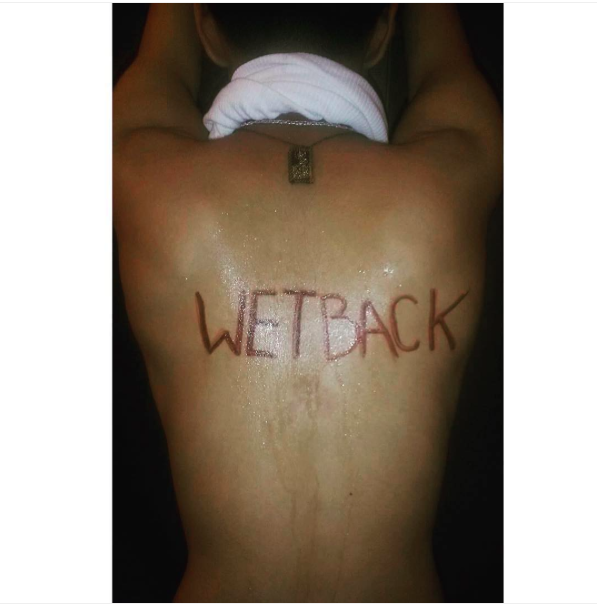
“My father works two jobs, six out of seven days a week. His fingers and toes are calloused; his body is weak. He suffers from high blood pressure, but never complains about feeling sick, at least not until he’s hospitalized. My mother works just as hard, fulfilling a domestic role while juggling a full time job. Though she is petite, small and dainty, she carries boxes twice her weight – bruising her body and ignoring fatigue in order to keep food on our family’s plates. My parents are hard workers. They crossed the Sonoran Desert by foot, withstanding treacherous conditions and hiding from circling helicopters for two days and three nights just to build a life in a country where they’re not valued or measured by the content of their character, but rather criticized for having “WETBACKS”. Like other Latinx and Chicanx people, my parents overexert themselves physically, in hopes of making ends meet. They budget like crazy and put aside their wants, as well as their needs. Their health comes second and children come first; they don’t ever have time to worry about feeling tired because they only have time to provide for our family. Earlier today, my mother, older sister and I, were targeted by a black man for being “WETBACKS”. We were called “lazy”, “uneducated” and “broke”. The cherry on top was being accused of depending on the government for financial support – a government which we contribute to through our paying taxes, so even if we did, what does it matter? This image is dedicated to the black man who judged my family based on our complexion, on our exterior that reflects the Anti-Immigrant/Anti-Latino Sentiments Republican Party Nominee, Donald Trump, proudly promoted. This image is dedicated to those who make a living off of their sweat in order to survive, to my undocumented brothers and sisters who feel caught in the in-between, en la frontera que divide nuestras identidades. Let’s never dry our backs for there is no shame in having a wetback when the same sweat that drips from our bodies is the same sweat that nourishes us.”
 Sandra Ruiz, Ph.D.
Thank you for sharing this. This student’s words spoke to my soul.