
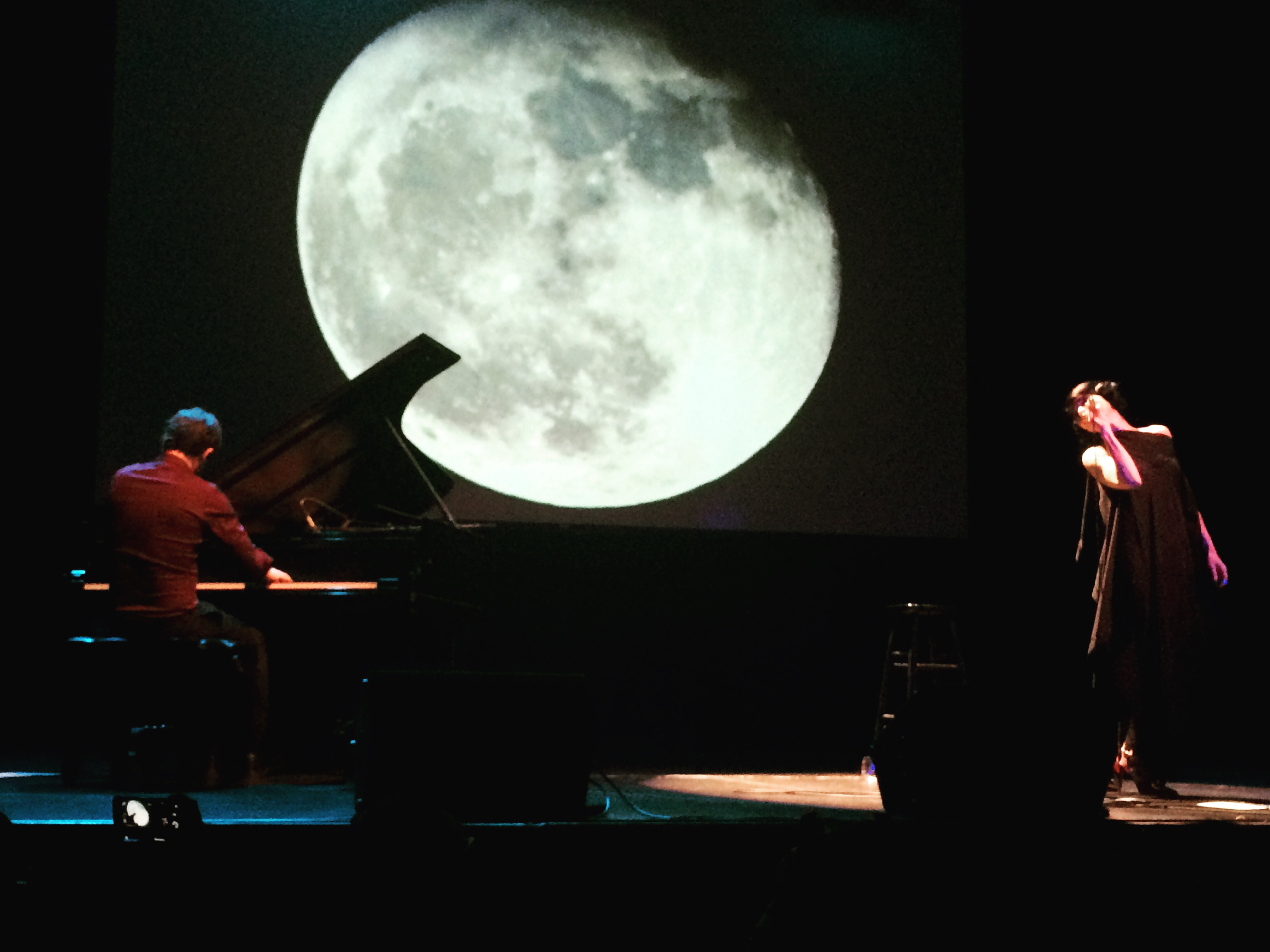
 At the end of the Spring Quarter UCLA announced their UC Regents’ Lecturers for 2015-2016, to the excitement of many, Mexican feminist songstress Ely Guerra was one of those selected few. If you’ve never heard of her or come across her brilliance, I strongly suggest you check out her video for her song “Yo no,” an unnerving critique on Mexico’s femicide epidemic. Part of Guerra’s lectureship not only included a visit to converse with Professor Héctor Calderón in his class on Mexican Literature and Culture (he is the mastermind behind Guerra’s nomination), but also an intimate concert titled “El origen”, the origin or the return. At the concert, instead of having the usual big band with all of the rock ‘n’ roll instruments, the stage was nearly bare with only Guerra, her voice and her longtime pianist. Her backdrop enhanced the ambience of the intimate setting, really providing a nearly invisible barrier between herself and her audience. I was captivated throughout her performance, she was charming, bilingual, hilarious and vulnerable.
There was a moment during her two hour set, mixed with old school Mexican music such as “La llorona” and “Júrame” to her wonderful “Colmena” song, where my eyes watered. She began to give the origin of her song “Prometo ser,” the relationship that inspired it and the imagined child that never came to be, at least not in the physical biological sense. The singer went on to explain that she never felt the need or want to be a mother, and if there has been anyone or anything that she has given birth to, then it would be the songs she has carefully crafted and created. Her description of how the song emerged resonated with me and I interpreted her disclosure as a powerful statement. Especially being part of a cultural world where motherhood is not only expected from Mexican women (and by extension Chicanas), but it is deeply etched into our psyche and to choose to redefine or break free from it as well as announce it so publicly is an act of subversiveness and self-determination. Professor Cristina Herrera has written a beautiful text, Contemporary Chicana Literature: (Re)Writing the Maternal Script (2014) where she discusses the complicated relationship between Chicana identity and motherhood, and how rewriting, reclaiming and redefining the mother identity brings forth a more empowered Chicana voice (8). Herrera’s research provides an important alternative discourse to Mexican-Chicana motherhood, while also creating a space for non-mothers, such as Sandra Cisneros who has proudly declared “she is nobody’s mother and nobody’s wife.” I thought it a poignant moment to have the moon emerge in Guerra’s backdrop as it immediately made me think of Coyolxauhqui, the Aztec deity known as the moon goddess who was a daughter who dared to defy her mother and her warrior brother, only to have her dismembered body placed in the dark sky. Luckily for us in the twenty-first century, Mexicana feminists like Guerra as well as Chicana scholars and writers like Herrera, Sandra Cisneros and Ana Castillo are whole, living and breathing beings, rewriting and subverting scripts promising that we can become “el cielo azul/la calle sola/el fresco aire de abril” and not “vivir a medias.”
 Sandra Ruiz, Ph.D.